
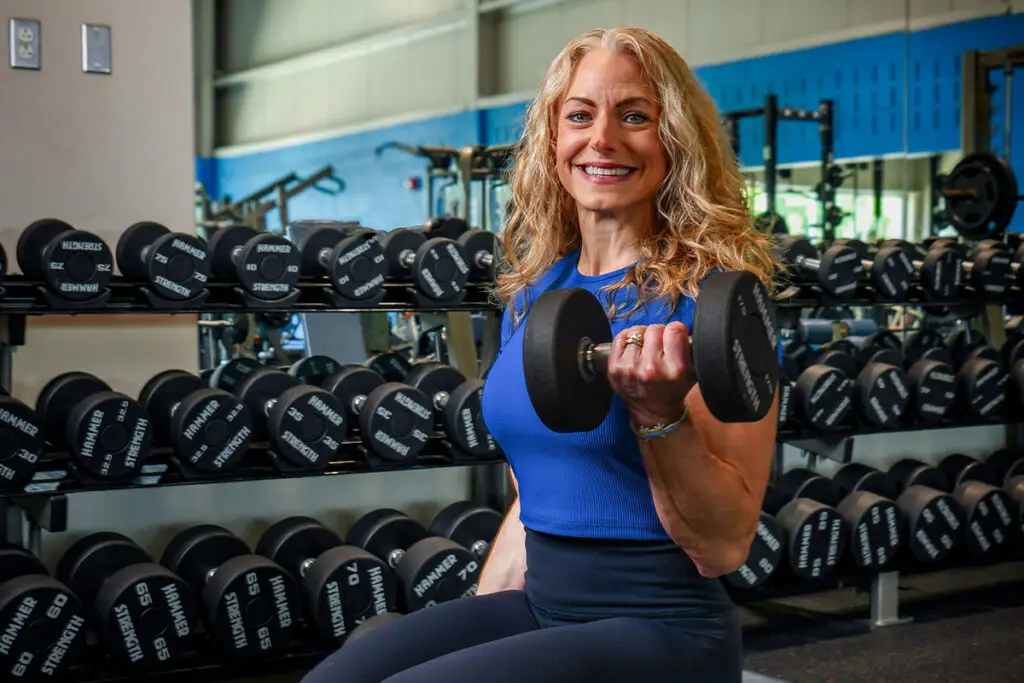
Tracy Eutsler, 51, had long been curious about bodybuilding but hesitated to try it. She finally took up the sport in 2023 and soon fell in love with the challenge. The wife and mother from Easton is the executive director of the Perkins Family YMCA in St. Michaels. In addition to her management responsibilities, she teaches group exercise classes.
Teaching provided her with exercise to maintain a healthy body, but she didn’t recognize her body’s potential for growth and symmetry. Honing her physique, she found, gave purpose to her workouts. It also helped her move past longstanding insecurities about her naturally muscular body.
“I used to think my legs were too big,” Eutsler said. “As I grew stronger and my upper body grew in proportion to my lower, the perceptions of my physique changed as I saw how my body adapted to working out. Now, I’m embracing my body for its ability to put on muscle, and I feel more confident and comfortable in my skin.”
A Buildup and a Breakdown
In 2024, as she lifted increasingly heavier weights as part of her bodybuilding regimen, Eutsler developed pain in her left elbow. Small modifications, such as the use of lifting straps, enabled her to continue her training. However, everyday tasks became increasingly difficult. “Eventually, I struggled to turn a doorknob, lift a cup of water or carry a bag,” Eutsler said. “When the pain got to that point, that was the straw that broke the camel’s back.”
Not-So-Heavy Lift

Eutsler met with Sheila Taylor, DO, sports medicine physician at The Orthopedic Center in Easton, a partner of UM Shore Regional Health (UM SRH). Dr. Taylor understood her patient’s desire to maintain her activity level.
She reviewed non-surgical treatments with Eutsler, including shockwave therapy. “We use shockwave therapy to treat chronic tendon pain, such as tennis elbow or golfer’s elbow,” Dr. Taylor said. “Tendons don’t have a good blood supply, so they don’t heal well when injured. Over time, with overuse or chronic irritation, they start to degenerate and thicken, and new, problematic nerve tissue forms.”
With shockwave therapy, sound waves penetrate the skin to increase blood flow and break up the abnormal nerve tissue. “Tracy was the perfect candidate for shockwave therapy because she needed to keep training for her competition season,” Dr. Taylor said. “We were able to reduce her pain and improve the health of the tendon while she continued to exercise. There was no downtime for her at all.”
Eutsler received three shockwave treatments over the course of several weeks (standard for this type of therapy), and now her pain is virtually gone. “I can do all the normal activities of daily living that I had problems with before,” she said. “When you have pain while typing or turning your wrist, it makes every day very uncomfortable. It’s a huge blessing to now have greater mobility and freedom in my activities.”

“It’s not normal to live in a state of discomfort. If you have pain, don’t just suck it up. Seek out a professional who can help you have a better quality of life. You’re not weak to ask for help.” — TRACY EUTSLER, A BODYBUILDER WHO HAD SHOCKWAVE THERAPY AT THE ORTHOPEDIC CENTER TO TREAT ELBOW PAIN
Active By Nature
Like Eutsler, Leo Marshall, 75, of Easton, also developed left elbow pain. As with Eutsler, the retired educator initially pushed through the discomfort. A lifelong athlete, Marshall engages in a variety of activities, including weightlifting. Lifting, he said, is “critical” at his age to maintain strength and flexibility.
Of all the physical activities he performs, though, cycling tops the list. “Cycling is my favorite by far,” Marshall said. “Pedaling the back roads of the Eastern Shore is glorious. You can cycle 30 or 40 miles on just country roads. It’s a wonderful aerobic exercise.”
Last year, elbow pain increasingly intruded on Marshall’s workouts, but he refused to give up his favorite activities. That didn’t help matters, he conceded. “It became harder to write, and sleeping was difficult,” Marshall said. “I backed off on any activities that involved overextending my arm, including my twice-weekly yoga.”
Rolling On
Finally fed up with the pain, Marshall made an appointment with Dr. Taylor. Knowing Marshall wanted a definitive solution, Dr. Taylor felt he was a good fit for a one-time procedure called minimally invasive hydro tenotomy. “This treatment is like a pressure wash for the tendon,” she said. “Using ultrasound guidance, we insert a needle-like device that sprays normal saline at a high rate of speed and sucks out the debris at the same time. As a result, we’re able to clean up the degenerative tendon tissue that is causing pain and stiffness.”
Marshall had the procedure in January 2025, followed by several weeks of physical therapy. Now, he’s back on his bike, has resumed lifting weights and is once again a regular presence on the yoga mat. Writing and sleeping are no longer challenging. Grateful for the care he received, Marshall has advice for other people with aching joints: Don’t wait as long as he did to seek help. “If you go two or three weeks without pain improving, it’s time to get checked by an expert,” he said.

“I can’t begin to tell you how good and easy everything was, and how well everyone took care of me. My experience was just terrific.” — LEO MARSHALL, A RETIREE AND AVID CYCLIST WHO HAD A MINIMALLY INVASIVE HYDRO TENOTOMY AT THE ORTHOPEDIC CENTER TO TREAT ELBOW PAIN
The Growing Popularity of Non-surgical Treatments

Myron Szczukowski, MD, orthopedic surgeon at The Orthopedic Center and UM Shore Regional Health, performed joint replacement surgeries for nearly 40 years. During that period, he said, numerous technological advancements transformed conservative treatments. Now, he offers only non-surgical therapies, such as cryoneurolysis (nerve freezing).
“Most patients would prefer to treat arthritis, back problems, tendonitis and other conditions conservatively,” Dr. Szczukowski said. “Non-surgical treatments can help control the pain and deficits of conditions like arthritis so patients can function better.”
Surgery may also require downtime for recovery. Non-surgical treatment can minimize disruption to your work or leisure pursuits. “Many non-surgical treatments allow patients to continue their activities while improving the issues they’re struggling with,” said Sheila Taylor, DO.
Non-surgical Pain Relief Options
Joint replacement and other surgeries can be extremely effective solutions for musculoskeletal problems, but orthopedic specialists rarely recommend them as the first treatment. One key reason: More non-surgical therapies are available than ever before. These treatments use innovative methods to reduce pain and improve function, such as using nitrous oxide to freeze painful nerves or sound waves to increase blood flow to injured tendons. For patients who want to avoid surgery or aren’t good candidates, non-surgical treatments can make a big difference in their quality of life.
Shockwave therapy and hydro tenotomy are far from the only non-surgical treatments available at The Orthopedic Center. They also offer:
- Percutaneous needle tenotomy is a minimally invasive procedure that uses a needle to break up scar tissue and stimulate healing in damaged tendons.
- Cryoneurolysis can provide months of relief from arthritis-related knee pain. Performed under local anesthesia, this procedure inserts a probe beneath the skin to deliver extreme cold to nerves, which temporarily stops them from transmitting pain signals to the brain.
- Platelet-rich plasma (PRP) therapy for tendon injuries, knee arthritis and certain other orthopedic conditions involves separating platelets from a sample of your blood and injecting them at the site of an injury to support healing.
- Cortisone injections are anti-inflammatory injections for arthritis pain.
- Gel injections include hyaluronic acid lubrication injection for arthritic knee pain.
- Customized physical therapy prescriptions and home exercise programs optimize strength and flexibility.
- Customized osteoporosis diagnosis and treatment improve bone health, reducing the risk of falls and fractures.
When Non-Surgical Treatments No Longer Provide Relief? Surgery To the Rescue

For Raymond Pagano, 44, life had long revolved around pain. The former Washington College lacrosse player who now lives in Chestertown had suffered for two decades after hyperextending his knee during a college game. What was initially brushed off as a manageable injury became a chronic condition that limited his activity.
“I relied on cortisone shots for 20 years,” Pagano recalls. “They helped at first. But as time went on, the pain just kept getting worse. I couldn’t be active without paying for it for weeks afterward.”
Last year, he hit a breaking point. “At The Orthopedic Center, Jason Jancosko, DO, scoped my knee and told me the damage was beyond what shots could fix,” Pagano explained. He was referred to The Orthopedic Center surgeon Stefano Muscatelli, MD, who recommended a partial knee replacement, and Pagano agreed.
“Dr. Muscatelli was excellent — really thorough,” he stated. “He even called me a couple of days after surgery just to check on how I was doing. That personal touch meant a lot.”
The results? Nothing short of transformative. “I’ve lost 10 pounds simply because I can move freely now,” Pagano said. “I can play soccer, lacrosse and basketball pain-free with my kids. My whole family is so happy, it feels like I got my life back.”
But Pagano is quick to emphasize that recovery wasn’t effortless, and he has a word of advice for others considering similar procedures. “Don’t skimp on physical therapy,” he urged. “Treat it like a job. It will make all the difference in your recovery.”

“Ray’s main goal was pain relief — and we achieved that, along with a dramatic improvement in his quality of life. His recovery was excellent, thanks to his strong commitment to physical therapy.” — Stefano R Muscatelli, MD
From chronic pain to playful afternoons with his kids, Pagano’s journey serves as a powerful reminder: The right diagnosis, the right care and the right commitment to recovery can truly change your life.
Listen to a Podcast
Non-surgical Treatments for Joint Pain
Do you live with daily joint pain? You are not alone. Fortunately, there are many options to get relief that do not require surgery. In this podcast, learn from Dr. Shelia Taylor and Dr. Myron Szczukowski, orthopedic specialists at The Orthopedic Center, a partner of UM Shore Regional Health, as they discuss the latest non-surgical medical therapies and procedures for pain relief.
More to Read
- Are Corticosteroid Injections the Right Treatment for Your Joint Pain?
- Keeping Exercise Safe: Warm Up to Win, Cool Down to Conquer
- Supplements for Joint Pain: Helpful or Harmful?
- Should You Be Concerned About Popping Joints?
Wondering whether a non-surgical treatment could help you thrive with less orthopedic pain? Call 410-820-8226 to find an expert at The Orthopedic Center who can discuss available therapies