
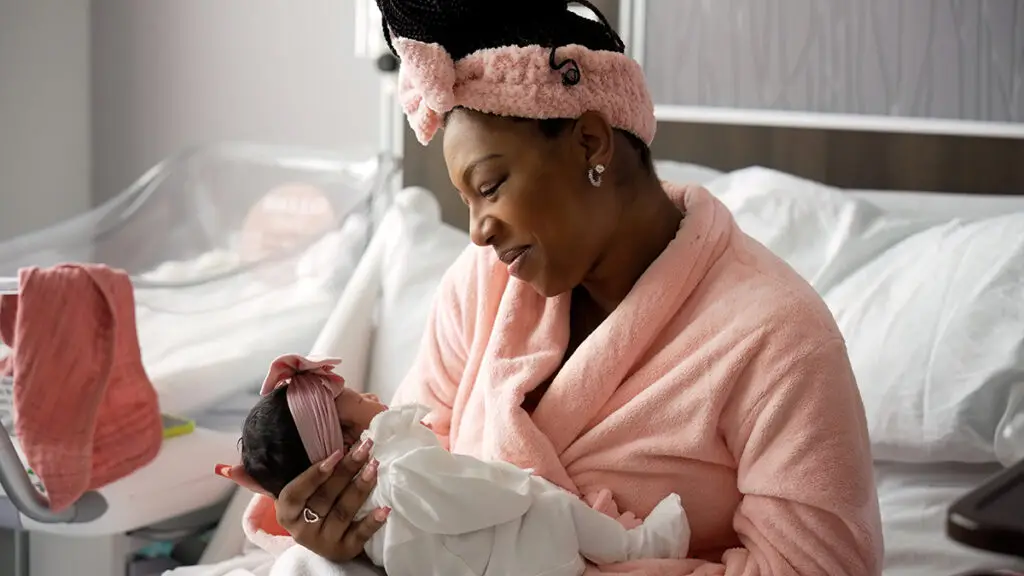
There’s no shortage of labor and delivery hospitals in Maryland, but more and more women in Prince George’s County are choosing to have their babies at UM Capital Region Health.
Kenisha Anderson didn’t just have her baby at UM Capital Region Medical Center—she’s also the women’s health services program coordinator here. She believes the uptick in deliveries at UM Capital Region Health is because obstetricians throughout the area trust the hospital’s labor and delivery team and refer their patients here.
The Key to Healthy Pregnancies and Deliveries? Seeing Your Provider Early in Your Pregnancy

Kerry Lewis, MD, OB/GYN, maternal-fetal medicine specialist and medical director of Women’s and Infants Services at UM Capital Region Health, said it’s important for women to seek obstetric care as soon as they see their first positive pregnancy test—which is exactly what Anderson did.
Women with normal, low-risk pregnancies should see their provider—who can be an obstetrician or a midwife—monthly during their first two trimesters. After that, they should see them every two weeks, then weekly as they approach their due date.
Women with risk factors during pregnancy, such as diabetes and autoimmune disorders, benefit from seeing obstetricians when planning to become pregnant to help reduce their risks of miscarriage and other complications.
Empowering Women Throughout Labor and Delivery

Billie Hamilton, RN, CNM, MPAS, a board-certified nurse midwife and director of both mobile health and midwifery services at UM Capital Region Health, said the hospital’s midwife program is another reason why more women are choosing to give birth here.
In 2021, Hamilton and her team assisted with approximately 40–45 births per month. That number has now increased to 90–100 births per month. To meet this demand, UM Capital Region Health is hiring more midwives to cover inpatient and outpatient clinics.
“We are increasing our staff size because more women want more control of their bodies and their labor process,” Hamilton said. As midwives, she and her colleagues explain medical jargon, educate pregnant women about healthy pregnancies, help them relax, and support their ability to express their preferences throughout pregnancy and delivery. These choices include medicated and natural births, as well as holistic delivery support.
“We can accommodate each woman’s wishes, regardless of the type of birth she desires,” Hamilton said. In many cases, women are surprised by the number of options available and how many of their preferences can be accommodated. For example, many women initially want to avoid epidurals. However, some women change their minds during labor. “We allow that to happen,” she said. “Patients have the right to change their minds during childbirth. That enables women to be more engaged in the experience and form positive memories. It also reduces the stress that occurs when providers don’t work with them.”
Midwives also offer nonmedical interventions, including showers, birthing balls, different birthing positions (such as standing and squatting), and more. The large labor and delivery rooms at UM Capital Region Health provide flexibility for alternative interventions while keeping women and their partners comfortable throughout labor and after delivery. After giving birth, women enjoy continued support, including breastfeeding information and a monthly support group.
Maternal-Fetal Medicine Specialists for High-Risk Pregnancies
Although midwives don’t handle high-risk pregnancies and deliveries by themselves, they can schedule consultations with OB-GYNs and maternal-fetal medicine specialists at any time during labor and delivery. They can also quickly address unforeseen complications through necessary interventions and transfer patients to specialty care.
There are many reasons a pregnancy might be considered high-risk. They include gestational and pre-existing diabetes, gestational and pre-existing hypertension (high blood pressure), being pregnant with twins or triplets, having lupus or human immunodeficiency virus, having a history of opioid abuse, and being 35 or older. When appropriate, providers refer women with these conditions to a maternal-fetal medicine specialist for additional monitoring during pregnancy.
UM Capital Region Health is also prepared for pregnancies with complications that may not be detected or diagnosed until later in pregnancy. These include fetal growth and placenta abnormalities, early cervical dilation, and a short cervix, Dr. Lewis said. By diagnosing and treating these risks early, doctors can help prevent miscarriage.
Preeclampsia is another late pregnancy complication that can be treated by maternal-fetal medicine specialists at UM Capital Region Health. This condition doesn’t manifest until the third trimester, and many women don’t present with complications or symptoms until the last month of pregnancy. At that point, their blood pressure may rise quickly, putting them and their babies at risk of serious complications. Previously, women with preeclampsia often needed to deliver at around 24 weeks. Now, treatment with baby aspirin helps women deliver much later, at around 33–35 weeks, which means far fewer complications for their babies.
Delivery Service in a Patient-Centered Environment

“At UM Capital Region Health, our OB and delivery service has a goal of achieving 100% patient-centered management to give all patients total involvement in their care,” Dr. Lewis said. “In addition, we strive never to deliver infants before they’re due unless it’s medically necessary. We work hard to accomplish this through testing and the management of high-risk conditions such as diabetes and hypertension.”
Another important aspect of a patient-centered environment is making women feel comfortable. The maternal services team strives to provide the best possible care to women and their babies by offering welcoming, spacious rooms, emphasizing clear communication between patients and providers, and leveraging the skills of a diverse staff.
Anderson said that UM Capital Region Health stands out as a labor and delivery center because of how its staff work together and communicate, and because it shares decision-making with its patients. “Patient care comes first,” she said. “We make sure patients have what they need. We put patients’ needs above our own, and we go above and beyond to ensure patients have safe and happy deliveries.”
UM Capital Region Health is quickly becoming the gold standard for labor and delivery in Prince George’s County. It features welcoming, spacious rooms with state-of-the art equipment and technology. Everything is designed to streamline and optimize the labor and delivery process for every patient.
OB and Delivery Floor Goes for the Gold
UM Capital Region Health is quickly becoming the gold standard for labor and delivery in Prince George’s County. It features welcoming, spacious rooms with state-of-the art equipment and technology. Everything is designed to streamline and optimize the labor and delivery process for every patient. Watch our video below to see our labor and delivery unit for yourself, or visit our website.