
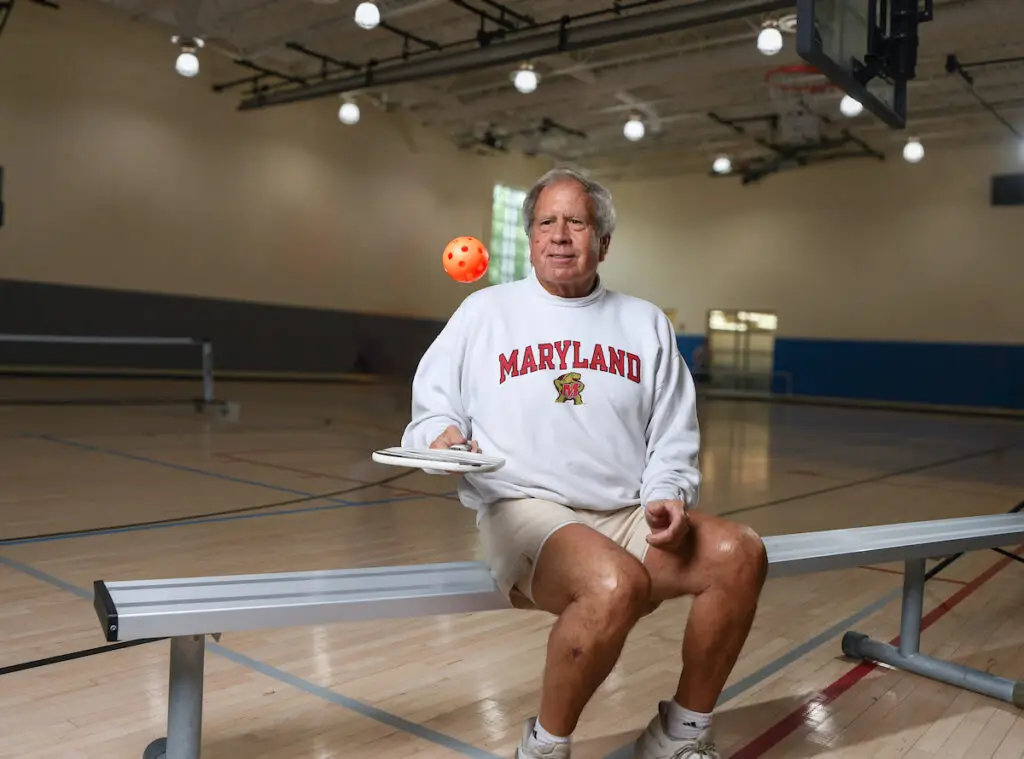
The full gamut of services covered at UM BWMC allows community members the renewed opportunity to put their whole — and healed — hearts into everything they do. Ellicott City resident Hal Hamil leads an active life. Since retiring in 2018, he has spent almost every day playing pickleball for hours at his local YMCA. “Pickleball has just gotten huge,” explained Hamil, who also calls the sport “addicting.” “It helps keep you active, and it really is a friendly game.” Last winter, the plan was to temporarily hang up his paddle for a quick surgery to repair a double hernia. During his pre-surgery assessment to check his vitals, the nurse and anesthesiologist became alarmed by his low pulse. The average adult has 60 to 100 heartbeats per minute, and Hamil was clocking 33 beats per minute. Hernia surgery would need to wait.
Serving Up Diagnosis and Treatment
“I was released around 7:30 in the morning with the recommendation to be in touch with my cardiologist as soon as possible,” Hamil said. Following their direction, Hamil did just that, calling his long-time doctor, Sambhav Karki, MD, a cardiologist with UM Baltimore Washington Heart Associates (UM BWHA), as soon as the office opened. “Thankfully, they could see me right away,” Hamil said. “At 11 am, I was in the cardiologist’s office having an EKG, and after that I wore a heart monitor.” “His EKG was not concerning, but a week with the heart monitor showed a third-degree atrioventricular blockage,” Dr. Karki said. “That means the top and bottom chambers of his heart were not connecting properly, electrically speaking. If left untreated, this condition could put Hamil at a high risk of cardiac arrest or even death.”
Turning The Beat Around
The best treatment option for Hamil was a pacemaker, an implantable device that helps keep the heart beating at a normal rate. The news shocked Hamil at first. At 72, he felt like he was too young to have this type of surgery, but his daughter, a nurse, reassured him that this was a pretty routine procedure. Originally developed in the 1950s, the first pacemaker was worn externally, and over time, it has evolved significantly. Dr. Karki referred Hamil to Bassim Badro, MD, a cardiologist at UM BWHA who specializes in electrophysiology, the electrical activity of the heart. “We typically do 200 pacemaker cases a year,” explained Dr. Badro, as across the country, a pacemaker is a relatively routine treatment option for patients with inconsistent heartbeats. UM BWMC was recognized for excellence in this procedure earlier this year, being rated “high performing” in pacemaker implantation by U.S. News & World Report.
Set For Life
Inside the recently renovated cardiac catheterization lab at UM BWMC, it took just about an hour for Hamil to receive a permanent dual-chamber pacemaker, meaning it has two leads, helping both the right atrium and the right ventricle work together to ensure a steady and constant heartbeat. “Almost immediately, my heart rate was normal, and my blood pressure was, too,” Hamil said. While most people go home the same day, Dr. Badro had Hamil stay overnight in the hospital for additional monitoring. From diagnosis to discharge, Hamil felt the cardiac team was very attentive and prioritized the entire process, making it seamless. Now, if Hamil’s heart beats too slowly or irregularly, the pacemaker will deliver an electrical impulse so the heart returns to normal function. Although the battery is expected to last 12 years, Hamil has regular six-month checkups to ensure the pacemaker is meeting his needs.
Rallying Again
After about six weeks recovering, Hamil was back playing pickleball almost every day of the week. On Wednesdays, he can often be spotted playing golf. Both Drs. Karki and Badro received the message loud and clear that Hamil’s goal was to pick up his pickleball paddle and golf clubs again. Back to his regular playing schedule, Hamil’s game has not changed with the pacemaker. “We strive to see patients quickly, and we really do offer comprehensive heart care here,” Dr. Karki said. “At UM BWMC, we have teams of people in cardiology, electrophysiology, interventional cardiology and heart failure. If we need something more advanced, like a bypass or even a heart transplant, we can refer to our colleagues downtown at the University of Maryland Medical Center.” “Hamil’s prognosis is good,” Dr. Badro said. “He is very active, and I have no concerns about him continuing with his usual activities,” but Dr. Badro laughed and added, “I may need to talk to him about not being too aggressive at pickleball.”
In His Own Words
Hear firsthand from Hal Hamil about his experience.