
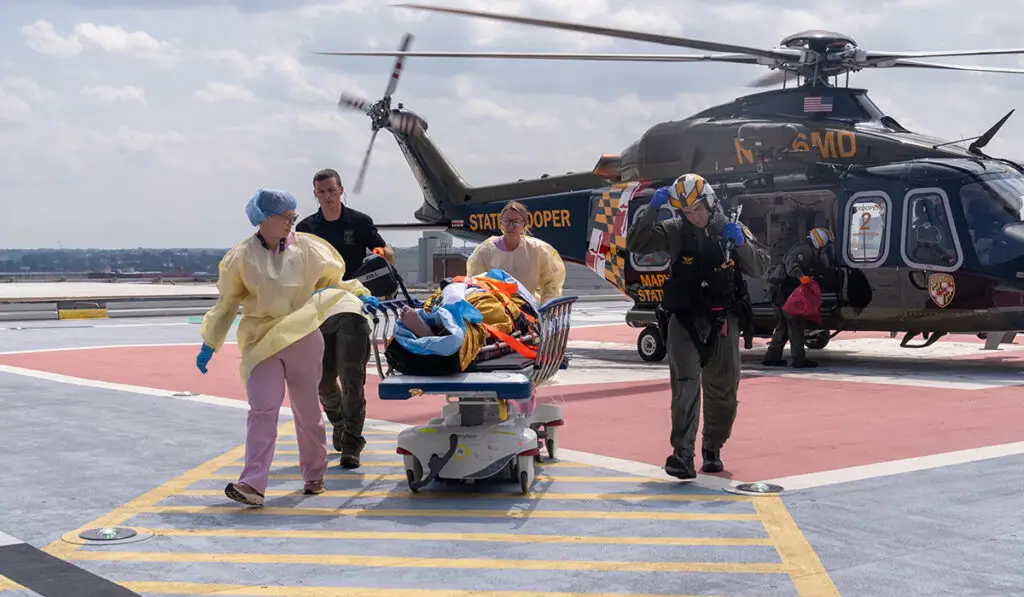
Pictured above: Patients transported from the scene of injury in a Maryland State Police helicopter are met by Shock Trauma staff in signature pink scrubs.
Like a scene from a sitcom, Gail Mogol was putting on her pants when she fell. There was no laugh track, though, and it quickly turned to a dark drama as she was taken by Baltimore City ambulance to the R Adams Cowley Shock Trauma Center at the University of Maryland Medical Center.
Rushed inside the Trauma Resuscitation Unit, a team of medical experts surrounded her and swiftly assessed her state. She had a broken femur (thigh bone) that required surgery to repair.
As one might expect, the University of Maryland Medical System’s world-renowned, top-rated Shock Trauma Center helps motor vehicle crash and violence victims, but close to half of all admissions stem from a fall. Between July 2024 and March 2025, 43% of patients were admitted for a fall, and 37% for motor vehicle crashes, the second most common cause.
Unfortunately, 81-year-old Mogol’s story is quite common. Like the 6,500 other patients who come to Shock Trauma each year, she was expecting a regular day, but then something went terribly wrong, causing her to become a trauma patient.
Statewide Safety Net
Established in 1973, the Shock Trauma Center, located blocks from Camden Yards, serves as a safety net for Marylanders and the national model for trauma and neurotrauma care. Teams of trauma experts are standing by 24/7 to receive, resuscitate, stabilize and treat people from across the state with life-threatening injuries. Unlike an emergency room that treats a wide array of minor and major problems, Shock Trauma exists to quickly treat the most severe and life-threatening injuries. Patients cannot just walk in the door at Shock Trauma.
Emergency medical technicians, or EMTs, transport patients from the scene of injury by either ground or air ambulance. The goal is to get patients into care within the “golden hour,” or the first 60 minutes after the incident. This significantly increases a person’s chances of survival. People who come by medevac are transported in a Maryland State Police helicopter, which is part of a longstanding, coordinated relationship with the State Police. Patients are never charged for this service and receive immediate access to lifesaving care when it matters most.
95% SURVIVAL RATE
At Shock Trauma, quick intervention and doing every single thing possible
saves lives!
Continuity of Care
After almost 10 days recovering at Shock Trauma, Mogol was transferred to the University of Maryland Rehabilitation and Orthopaedic Institute, where many Shock Trauma patients continue their recovery. There, she received targeted rehabilitative care that included balance training, strength-building exercises and gait retraining to restore her stability, coordination and confidence in movement.
With independence at the forefront of her goals, Mogol returned home, where she continues to improve. “The only place to go is Shock Trauma,” she said when asked to reflect on this experience. “They provide the best trauma care. I truly believe that.” Mogol added one more thought. “Sit down to put on your clothes.”
Emphasis on Prevention
“We believe that every injury is preventable,” explained Kristin Barron, PT, DPT, supervisor of the Injury Prevention Program at Shock Trauma. “That’s why there is a strong emphasis on prevention and education.” Programs and initiatives developed in alignment with the most common types of injuries at Shock Trauma help people stay safer. From distracted driving and violence prevention to water safety and concussion prevention, there are programs for all ages, all free of charge.
Guard Against Falls
Fall prevention is another example. Every month, caregivers and patients are invited to attend a fall prevention class offered both on-site at Shock Trauma and virtually. The class covers topics such as home modifications, medication management, fall recovery and exercise.
While some fall prevention tips may seem simple, they’re effective and worth repeating. “The education we offer is really about engagement and helping the information stick with people,” Barron said. “Many are surprised to learn that even their prescribed medications can contribute to falls,” added Kena Kuwera, PT, DPT, one of Shock Trauma’s Injury Prevention Program Coordinators. “Our goal is to empower attendees to speak up and not downplay their concerns when talking with health care providers.”
Healing with Hyperbaric Medicine


Here in Maryland, rates of people experiencing carbon monoxide (CO) poisoning increased last winter. Known as the silent killer because it is colorless and odorless, CO can reach deadly levels from faulty furnaces, generators and cars. Hyperbaric oxygen therapy, which uses high-pressure 100% oxygen to speed healing, is a treatment for individuals exposed to CO on the job or at home, divers with decompression sickness or other injury, and people with hard-to-heal wounds. Shock Trauma is home to the largest hyperbaric chamber in the Mid-Atlantic region (shown above), with enough space to treat up to 23 people at once. Like every other service at Shock Trauma, the hyperbaric chamber is available 24 hours a day, 7 days a week.
A Tool for Research
For older adults, falls are the leading cause of traumatic brain injury (TBI). Perhaps one day, the hyperbaric chamber at Shock Trauma could be used to reverse the damage caused by a lack of oxygen during a TBI. “That’s just one of the dozens of research projects taking place at Shock Trauma right now,” said Rosemary Kozar, MD, PhD, a professor of surgery at the University of Maryland School of Medicine and director of translational research at Shock Trauma. “Our goal is that our research contributes to better treatments in the future.”
STOP THE BLEED®
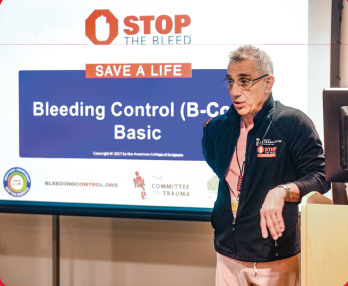
The Center for Injury Prevention and Policy, established in 2011, focuses on injury trends and prevention-based educational programs offered throughout the State of Maryland. One of these, Stop the Bleed, is a free class offered dozens of times each month across the state in schools, businesses, religious institutions, and at Shock Trauma to help bystanders learn to become lifesavers when they see someone bleeding uncontrollably.
Like CPR and defibrillator (AED) training, participants are taught to use hands, pressure, clothes and tourniquets to help prevent someone from bleeding to death. After an hour-long class, participants leave informed and ready to take action quickly because every second counts — someone can die from uncontrolled bleeding in 5 to 10 minutes. Find a class.
Pictured: Physician-in-Chief of Shock Trauma since 1997, Tom Scalea, MD, knows how to save a life and lends his expertise to a Stop the Bleed session.