
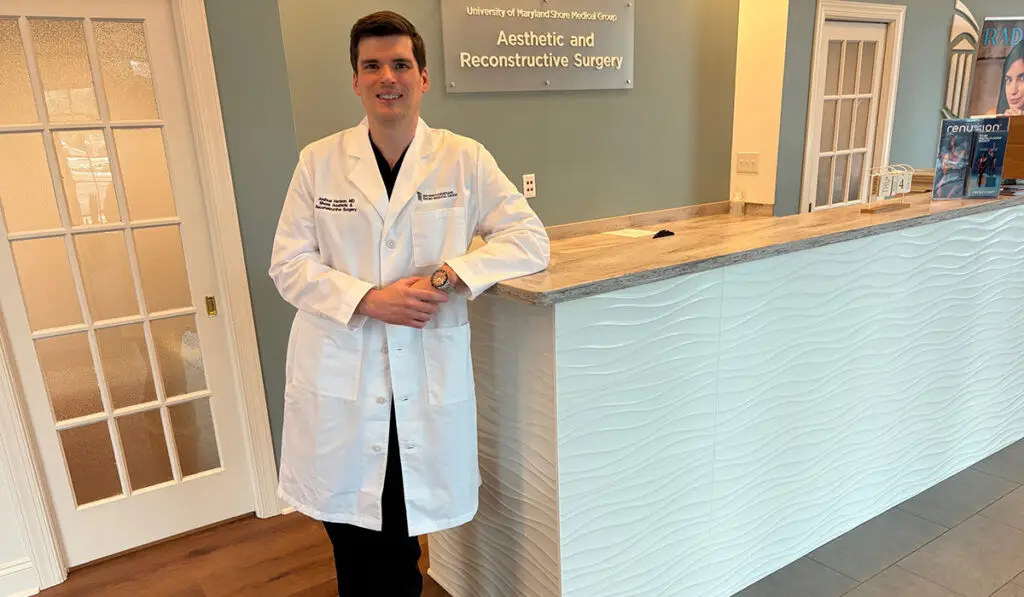
Advances in technology have transformed plastic surgery, making procedures more precise, less invasive and more personalized. Today, patients can choose from a wide range of reconstructive surgeries and non-surgical treatments designed to restore function, enhance appearance and improve quality of life.
Josh Harrison, MD, medical director of Shore Medical Group – Aesthetic and Reconstructive Surgery, discusses how these options are helping patients achieve their goals.
Q: Demand for non-surgical cosmetic treatments has been rising significantly during and since the pandemic. Are there recent advances that make them more appealing and/or effective?
Yes, as awareness grows, patients are seeking nonsurgical cosmetic treatments at a higher rate, driven by ongoing advances in cosmetic technologies, including lasers, dermal fillers, and skin-tightening devices. These procedures often deliver modest improvements with minimal downtime.
On the nonsurgical side, we offer a wide variety of lasers, injectables, and chemical peels. On the surgical side, we offer a state-of-the-art body contouring experience with ultrasonic liposuction and skin tightening.
Q: What are the key considerations for women interested in breast reduction or augmentation surgery?
As a functional procedure often covered by insurance, breast reduction surgery can relieve back and neck pain by removing excess weight from large breasts. You may be a candidate for breast reduction if you have tried nonsurgical measures to relieve back and neck pain but were unsuccessful, and you are at a stable body weight without plans for future weight gain or loss.
Breast augmentation is cosmetic surgery used to increase the patient’s breast size to achieve the patient’s aesthetic goals. Breast augmentation has been shown to improve patients’ confidence and sense of well-being.
In both cases, the patient must be 100% nicotine free prior to being considered for either procedure.
Q: Can breast reconstruction be done simultaneously with breast cancer surgery? Does reconstruction usually involve implants?
For the appropriate candidate, immediate breast reconstruction may be performed at the time of mastectomy, and yes, the most common type of reconstruction performed in the United States is with breast implants. Most of our patients undergo a two-stage reconstruction with breast tissue expanders at mastectomy, and the final implant is placed approximately three months later. There are additional options, such as using the patient’s own tissue for reconstruction and single-stage reconstruction with breast implants. We determine the most appropriate approach for each patient during the consultation.
Q: In addition to aesthetic and reconstructive surgery, you are credentialed in hand surgery. What are the most typical hand surgeries you perform?
One lesser-known fact about plastic surgery training is that a significant portion of the curriculum covers the full breadth of hand surgery. Most hand surgeries that I perform are elective procedures, including carpal/cubital tunnel releases, cyst excisions, trigger finger releases, and soft tissue reconstructions.
Q: What inspired you to choose plastic surgery as your medical specialty?
I was drawn to plastic surgery because I liked the wide variety of methods that plastic surgeons use to treat patients. I believe plastic surgeons can restore patients to a level of functionality near their pre-disease state through reconstructive surgery. Additionally, the broad range of aesthetic procedures available in plastic surgery enables plastic surgeons to enhance their patients’ confidence and well-being.
Q: Is the microsurgical training that you completed standard for plastic surgeons or an additional advantage you offer as a provider?
Microsurgical training is required in the standard plastic surgery residency curriculum. However, during my residency, I had the rare opportunity to spend one month at MD Anderson in Texas and two months at Chang Gung Memorial Hospital in Taiwan as a visiting scholar. This dedicated microsurgical experience has allowed me to hone my skills in complex reconstruction, and I consider it an advantage I offer as a provider.
Services offered by UM Shore Medical Group – Aesthetic and Reconstructive Surgery include: facial aesthetic surgery, breast augmentation and reconstruction, body contouring, skin cancer reconstruction, scar revision and non-surgical treatments as described above.
To schedule a consultation with Dr. Harrison, call UM Shore Medical Group – Aesthetic and Reconstructive Surgery at 667-343-1087.